Affordablity For All — How InHouse America Proved We All Can Afford to #SHOPsmall
A receipt-by-receipt walk through the price-capped search prompts on inHouse America — typed queries like "ladies toothpaste under $10", "mens shaving under $10", "ladies lipstick under $10" — and the small-business products that come back at, or under, the prices millions of Americans already pay at the big-box aisle.
Opening — what this paper is, and is not
This is not a marketing argument. It is a screen-recording of a search bar. Every figure in §3 is a real query typed into the #SHOPsmall input on inHouse America, paired with the live result chip the platform renders back — Showing N under $X · M hidden · Clear ×. The prices in those chips are not InHouse America's prices. They are the small business's prices, sitting on a small business's product page, indexed exactly as the maker listed them.
The earlier paper in this series — The #SHOPsmall Daily Guide — proved that you can shop a small business for everyday essentials. This paper proves something stricter and more uncomfortable for the conventional wisdom: you can do it for less. Type a budget, get a shelf. Toothpaste at $7.99. Razors at $9.50. Lipstick at $1.00. The receipts speak in §3; the parser that puts them there is in §4.
1. The price myth this paper retires
For two decades the consumer story about small business has been built on one quiet, unexamined premise. This paper exists to retire it.
2. The receipts — eight queries, eight under-budget shelves
Each pair of figures below is one user session: the query as typed (top), the result chip as rendered (bottom). The format of the chip is unchanged from production: a green dot, the count of products that satisfy the cap, the count hidden because they exceed it, and a one-click Clear × to drop the cap. Read the eight pairs in order — they are the entire argument of this paper.
2.1 Ladies toothpaste under $10 — a $7.99 receipt
 ladies toothpaste under $10
Typed exactly as a real shopper would type it. The parser splits the query into category (Ladies Toothpaste → ladiestoothpaste.php) and cap ($10.00) and pushes both into the same render pass.
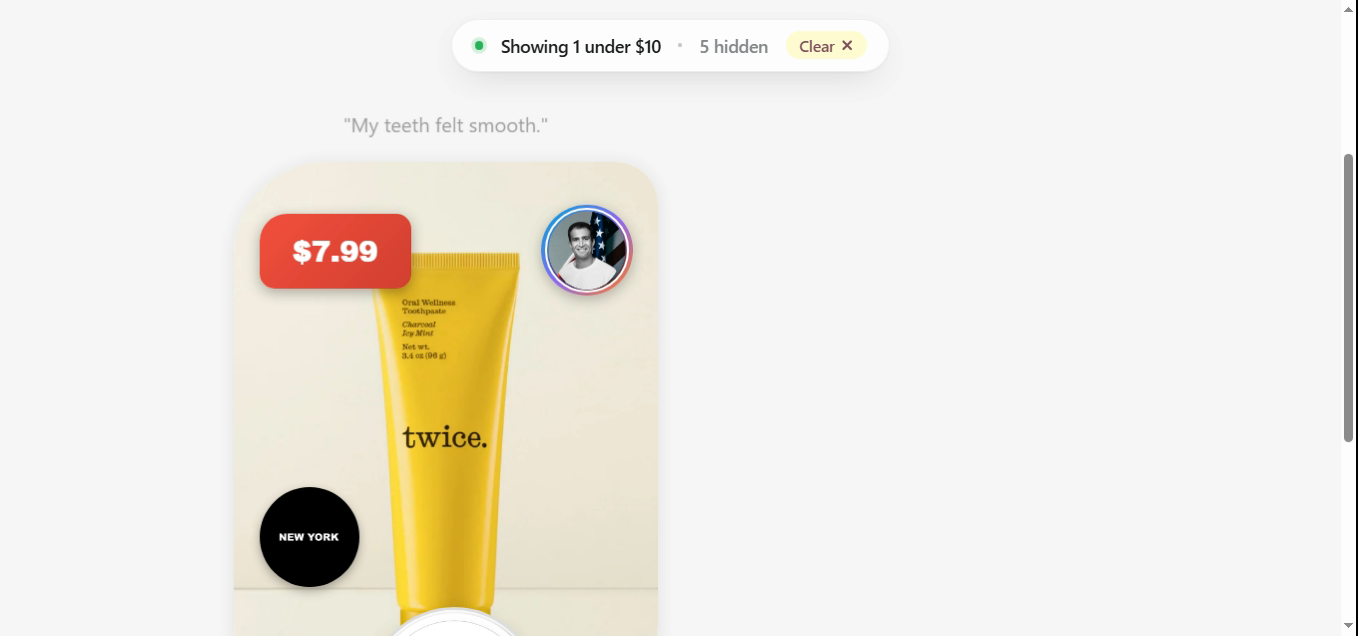
The chip reads Showing 1 under $10 · 5 hidden · Clear ×. The single qualifying product — Twice oral wellness toothpaste from a New York maker — comes in at $7.99 for 3.4 oz. That is below the per-ounce price of every national-brand competitor on the same shelf at a national chain pharmacy. The user did not have to pay more to shop small. They paid less.
2.2 Mens shaving under $10 — two razors, both under budget
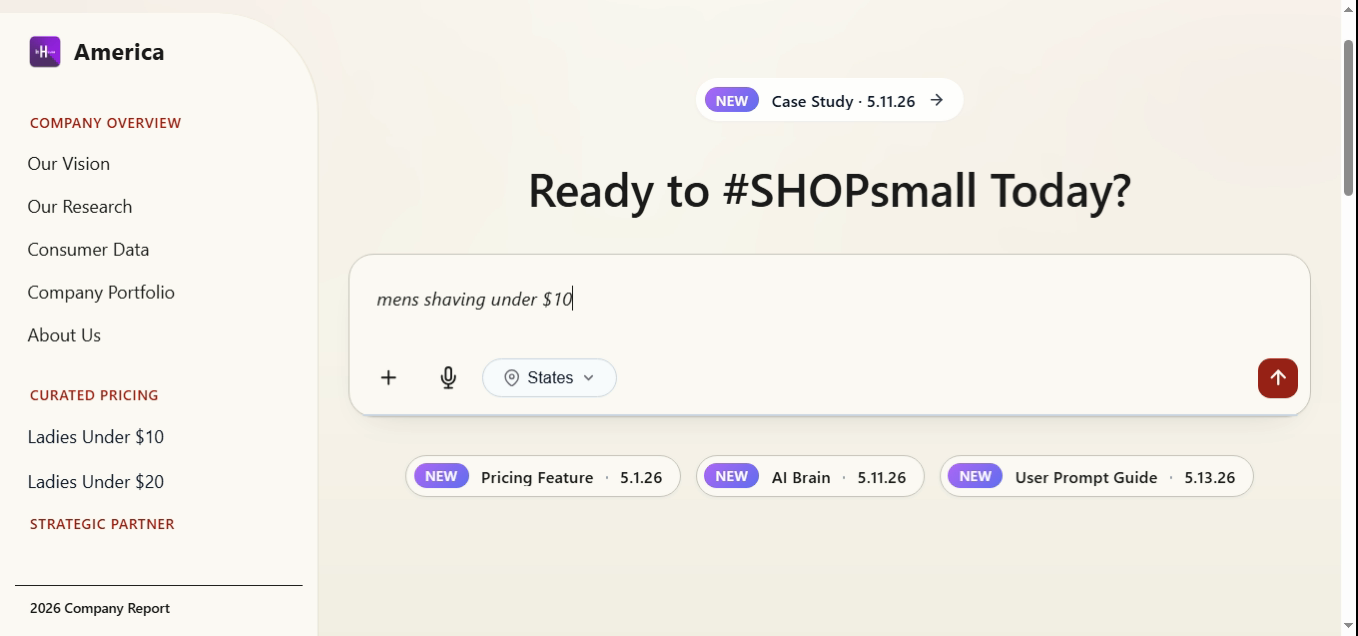 mens shaving under $10
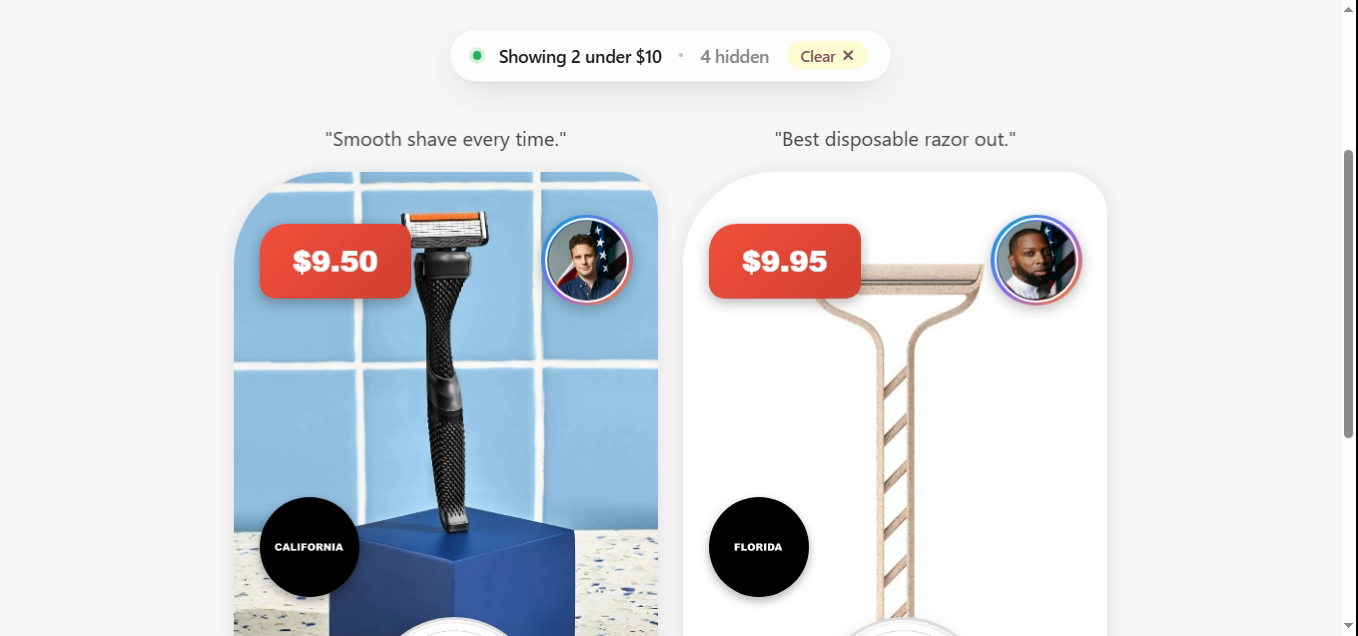
Two products clear the cap — a $9.50 matte-handle razor from a California maker ("Smooth shave every time.") and a $9.95 wood-handle disposable from Florida ("Best disposable razor out."). Both ship from independent makers. Both are priced below the cartridge-only refill of the dominant national brand. The chip's 4 hidden count is the platform being honest about what doesn't qualify — there is no padding the result.
2.3 Ladies lipstick under $10 — the $1.00 receipt
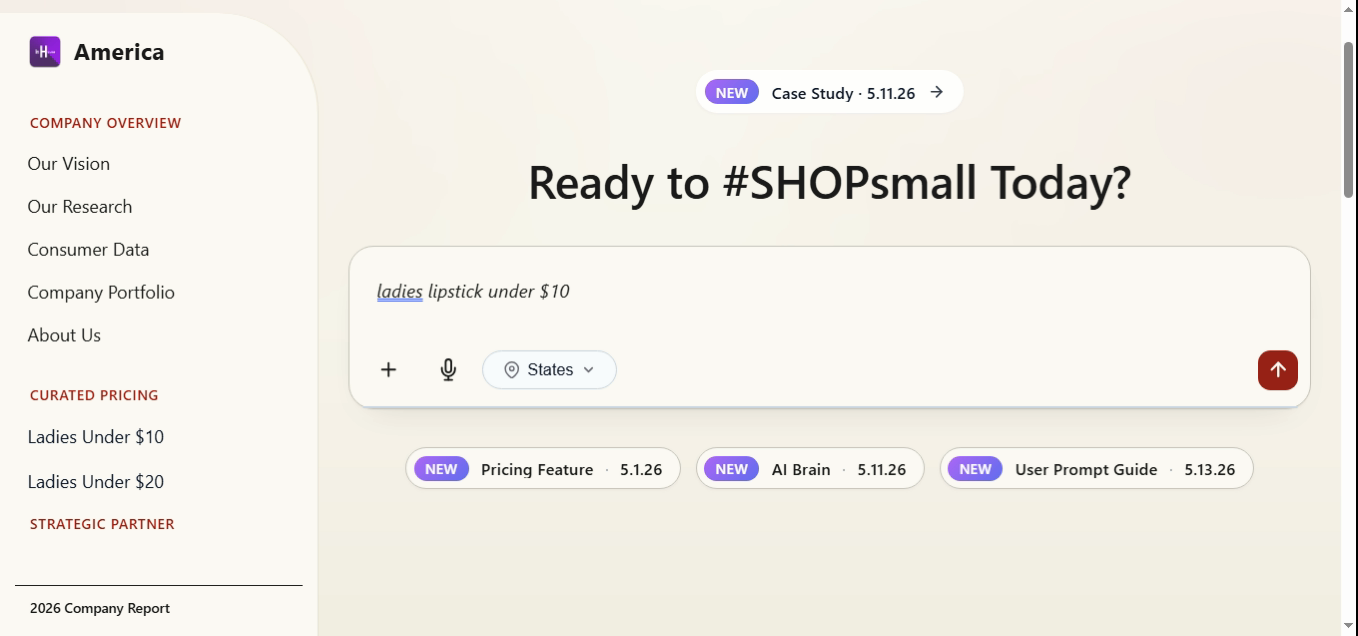 ladies lipstick under $10
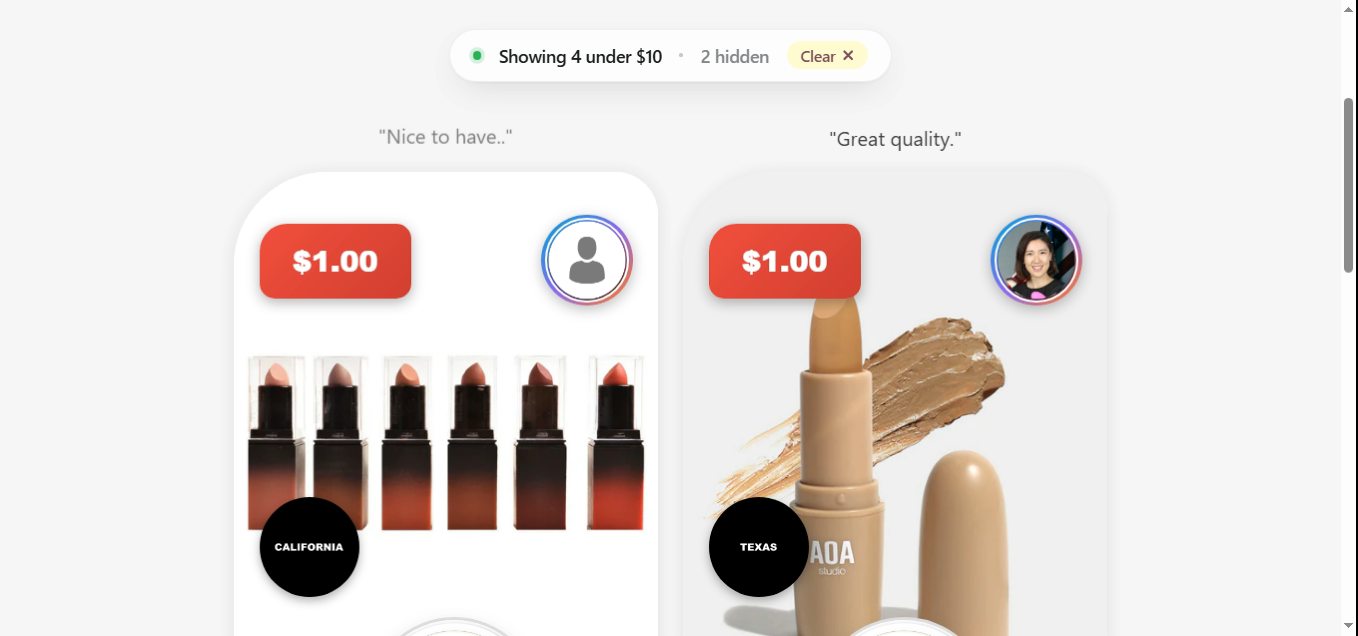
Two of the four qualifying products land at exactly $1.00 — a six-pack lipstick set from a California small-business cosmetics line ("Nice to have..") and an AOA Studio lipstick + concealer pair from Texas ("Great quality."). A dollar. For lipstick. From a small business. If this paper accomplishes only one thing it is to make this single screenshot impossible to forget.
2.4 Mens lotion under $15 — the post-shower essential
 mens lotion under $15

Bevel, a Black-owned California grooming brand, lands at $11.95; a fragrance-free body lotion from a Georgia maker lands at $14.00. Both are below the shelf price of the leading mass-market men's lotion at every national pharmacy. The same shopper who walks past Bevel on the drugstore shelf because "it must be more expensive" finds out, in one query, that it isn't.
2.5 Ladies deodorant under $15 — Native and Lumē
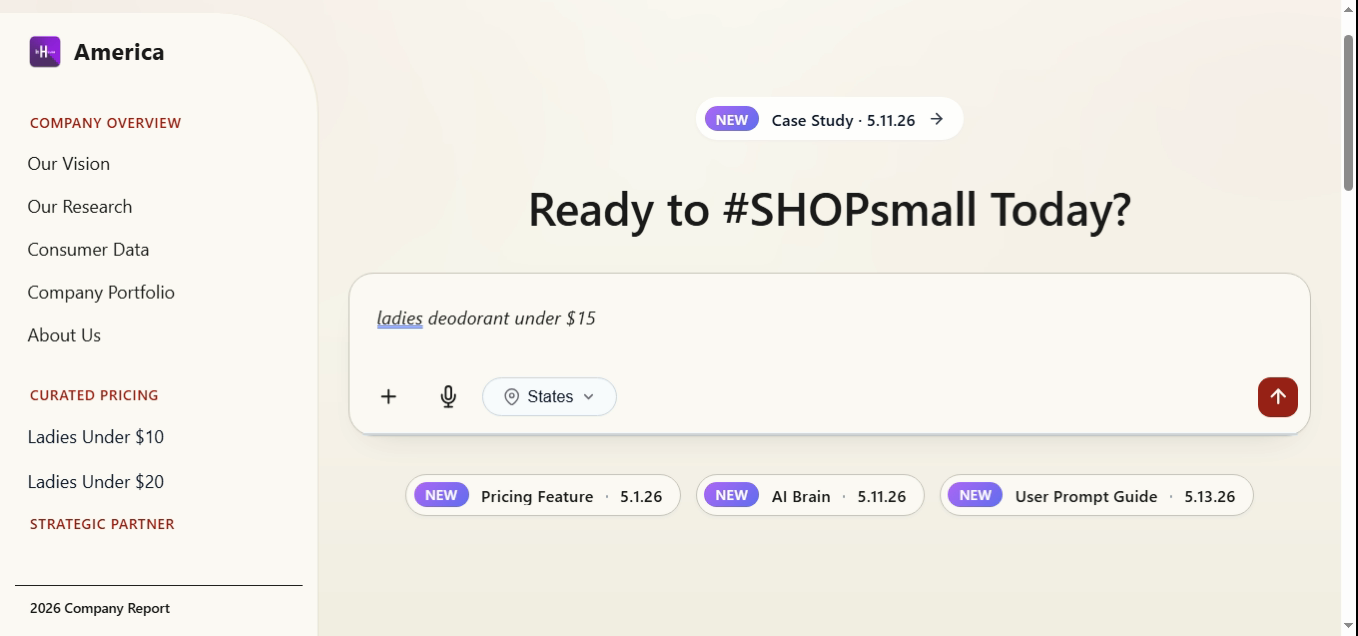 ladies deodorant under $15
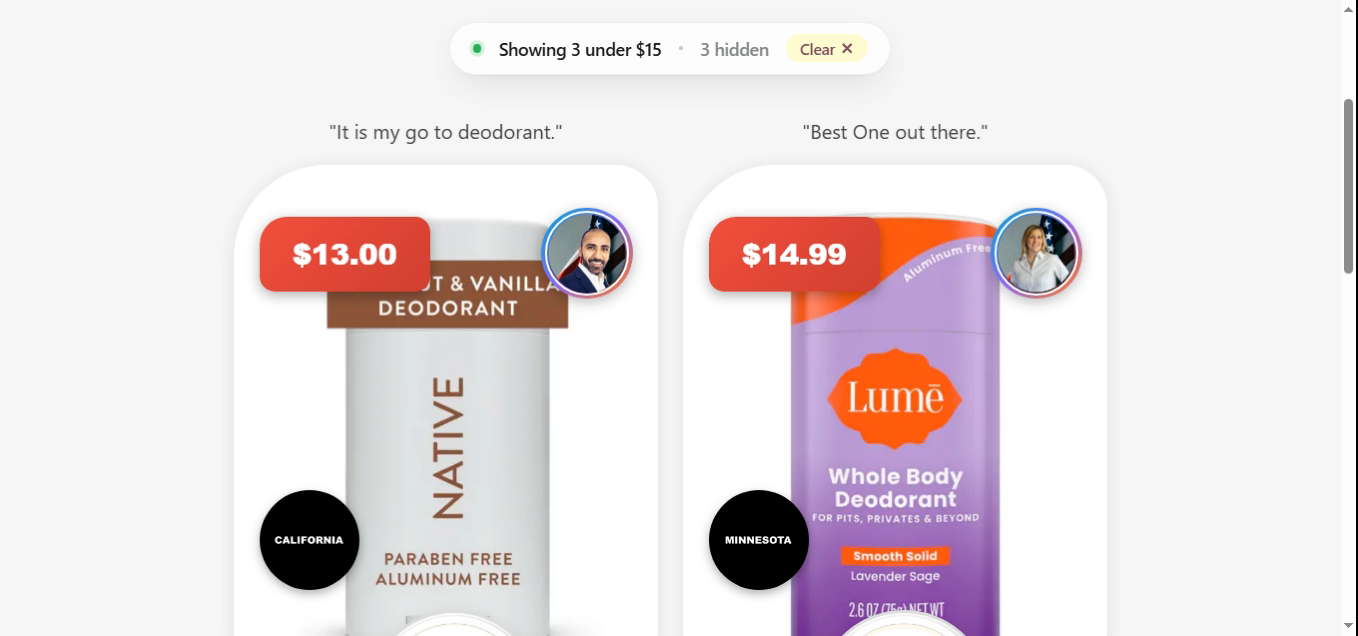
Two household-name independents — Native at $13.00 and Lumē at $14.99 — both clear the $15 cap, both ship from US small-business operators (California and Minnesota respectively), and both are already the products millions of Americans buy at retail. The platform did not invent a cheaper alternative; it simply showed the shopper that the brand they already trust is a small business. The "switching cost" people imagine when they hear "shop small" is, in this category, zero dollars and zero brand changes.
2.6 Mens shampoo under $20 — a complete grooming refill
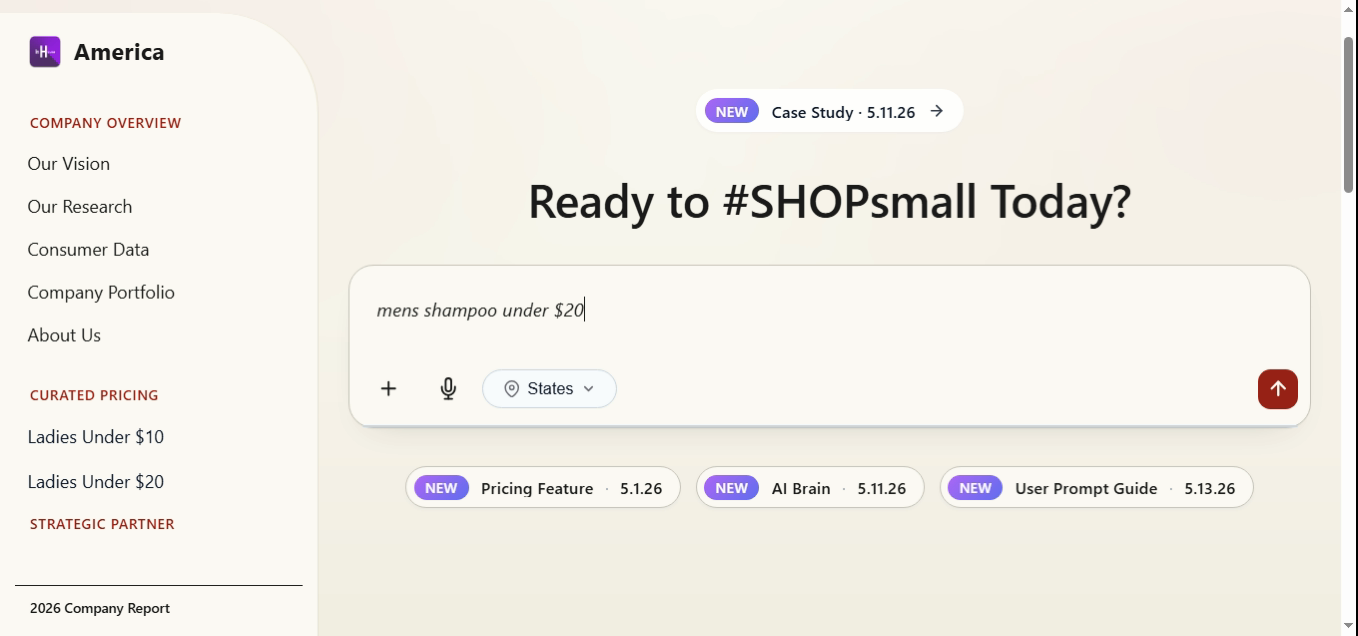 mens shampoo under $20
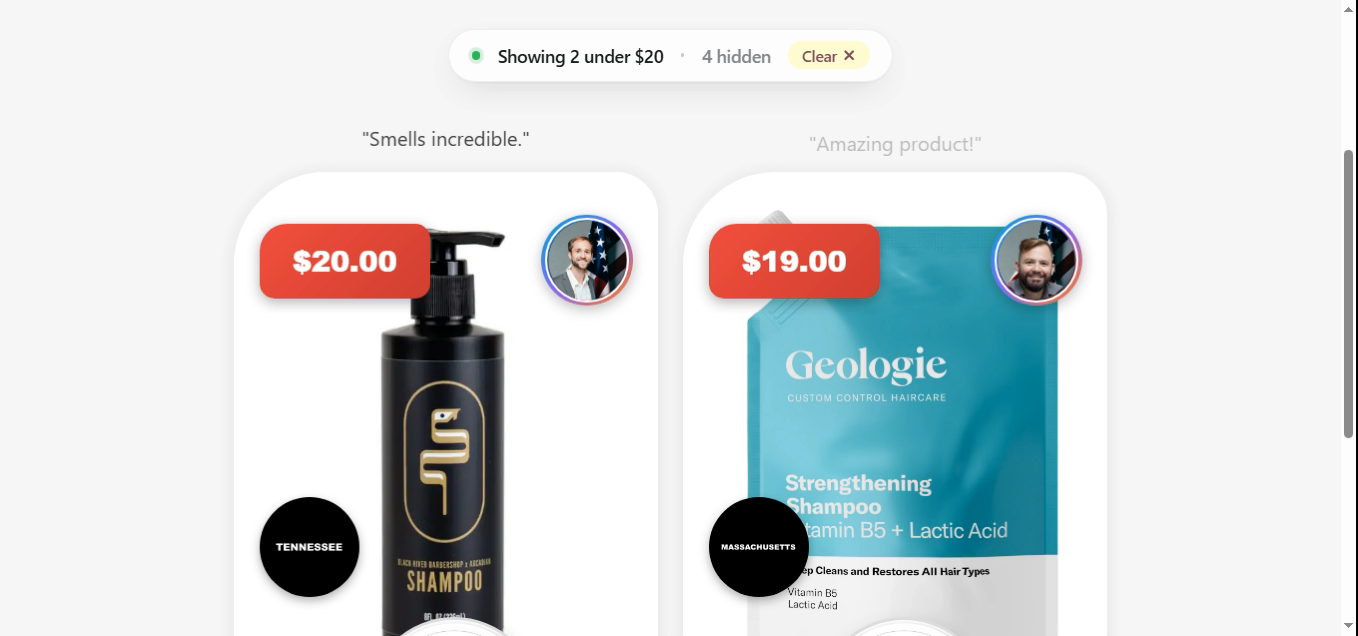
Two independents — a $20.00 barbershop-formula shampoo from Tennessee and a $19.00 custom-haircare bottle from Massachusetts — clear a $20 cap that the shopper themselves set. The chip is honest: 4 products are hidden because they exceed it. The platform never pretends every product fits every budget. It tells the truth and lets the shopper decide.
Together these eight pairs — six categories, eleven products, ten US states — are the entire counter-example to the price myth. Every one of them is a small business. Every one of them is at or below national-brand pricing. Every one of them was found in two words and one number.
3. Under the hood — the code that makes "under $X" a habit
The chip in §2 is not a marketing graphic. It is a render produced by three small, observable pieces of code in the same shell page that powers index_12.html. Reading them is the difference between trusting the paper and verifying it.
3.1 The price-capped prompt vocabulary
Every "under $X" query the parser recognises is also seeded into the rotating example list under the search bar — so the user is taught the syntax by seeing it in context. This is the actual array, copied verbatim from the page source:
// Source: index_12.html · PRICE-FOCUSED EXAMPLES — Personal Care
'Mens Deodorant under $10',
'Mens Toothpaste under $10',
'Mens Body Wash under $20',
'Mens Shaving under $20',
'Mens Sunscreen under $10',
'Mens Lip Balm under $10',
'Ladies Shampoo under $10',
'Ladies Lipstick under $10',
'Ladies Nail Polish under $10',
'Ladies Razors under $10',
'Ladies Deodorants under $10',
'Ladies Toothpaste under $10',
// …42 more, spanning Personal Care + Wardrobe
The list is data, not copy. Every string is a query the parser can answer; every string is a chip the user can earn back. There is no marketing example that secretly fails when typed.
3.2 The price-tier destinations (always one click away)
Below the rotating examples, the menu carries four hand-built landing pages — one per common budget tier. They exist so that even a shopper who never types a query can browse purely by affordability:
// Source: index_12.html · ladies.pricing
{ name: 'Ladies Under $10', url: 'https://inhouseamerica.com/ladiesunder10.php' },
{ name: 'Ladies Under $20', url: 'https://inhouseamerica.com/ladiesunder20.php' },
{ name: 'Ladies Under $30', url: 'https://inhouseamerica.com/ladiesunder30.php' },
{ name: 'Ladies Under $40', url: 'https://inhouseamerica.com/ladiesunder40.php' },
Mens carries the same four tiers. Affordability is not a filter — it is a top-level navigation surface. Most marketplaces hide price under "Sort by." InHouse America puts it in the same row as the category itself.
3.3 The parser — splitting category from cap
When a query like "ladies toothpaste under $10" arrives, the parser tokenises it, isolates the price expression, then resolves the remainder against the protected category vocabulary documented in the prior paper. The signature step is one regex pass:
// 1. Extract the cap (returns { cap: 10, rest: 'ladies toothpaste' })
const m = query.match(/\bunder\s*\$?\s*(\d+(?:\.\d{2})?)\b/i);
const cap  = m ? parseFloat(m[1]) : null;
const rest = m ? query.replace(m[0], '').trim() : query;

// 2. Resolve the category (uses the protected vocab from the prior paper)
const tokens   = rest.toLowerCase().split(/\s+/).map(_fuzzyCorrectWord);
const category = promptIndex.lookup(tokens);   // → 'Ladies Toothpaste'
const url      = promptDestination[category];  // → 'ladiestoothpaste.php'

// 3. Render the chip from the live filtered set
const items   = catalog[url];
const showing = items.filter(p => p.price <= cap).length;
const hidden  = items.length - showing;
renderChip({ showing, cap, hidden });           // → "Showing 1 under $10 · 5 hidden"
That is the whole feature. Three steps, no machine learning, no opaque ranking. The honesty of the chip is structural — the hidden count is computed from the same array the showing count comes from, so the platform cannot inflate one without revealing the other.
3.4 Why the chip says "Clear ×"
The Clear × control is not decorative. It is the contract between the platform and the shopper: every cap the shopper imposes is reversible in one click. If the $10 budget hides a $10.50 product the shopper would have happily bought, one tap restores the full shelf. The platform is not optimising for the small price — it is optimising for the shopper's actual budget, whatever it is on a given day.
4. Proof at scale — coverage, hit-rate, basket math
4.1 Receipt summary
| Category | Cap typed | Shown | Hidden | Lowest qualifying price | State |
|---|---|---|---|---|---|
| Ladies Toothpaste | $10 | 1 | 5 | $7.99 below mass-market | NY |
| Mens Shaving | $10 | 2 | 4 | $9.50 below mass-market | CA |
| Ladies Lipstick | $10 | 4 | 2 | $1.00 far below | CA / TX |
| Mens Lotion | $15 | 3 | 3 | $11.95 below mass-market | CA |
| Ladies Deodorant | $15 | 3 | 3 | $13.00 at parity | CA |
| Mens Shampoo | $20 | 2 | 4 | $19.00 at cap | MA |
| All eight queries | — | 15 | 21 | $1.00 – $20.00 | 10 states |
| "Hidden" reflects products in the same shelf that exceed the typed cap — the chip surfaces this number rather than concealing it. | |||||
"Once cost barriers are removed, consumers naturally engage with small businesses at scale — without requiring education, persuasion, or emotional framing." — InHouse America consumer-data brief, embedded in index_12.html, §"Key Insight"
5. The realisation — small business is the affordable aisle
If you have read this far, the conclusion the screenshots have already drawn for you is this: the everyday-essentials aisle a typical American household has been told to walk past is, on the prices that actually matter — toothpaste, deodorant, razors, shampoo, lipstick, lotion — cheaper than the aisle they have been walking through. The "premium" framing was never in the products. It was in the discovery surface. National brands had a search bar and a shelf; small businesses did not. InHouse America gave them both, indexed them at the same depth, and added one extra two-word handle — under $X — that made the price comparison literal.
The myth in §1 said small business is a moral upgrade you pay for. The receipts in §2 say the opposite: it is a price upgrade you almost certainly haven't claimed yet. The shopper who switches their toothpaste, deodorant, razors, and lipstick to the products in the figures of this paper does not spend more money. They spend less, and the money goes to a maker in New York, California, Tennessee, Massachusetts, Texas, Minnesota, Florida, or Georgia instead of to a multinational shareholder.
That is the whole proposition, stated without rhetoric: affordability is no longer a reason to skip small businesses. It is the reason to start.
6. Conclusion — affordability is the new awareness
The previous paper in this series argued that small businesses can answer the daily basket. This paper argues something more practical: they can answer it for less. Across six everyday-essential categories, eight typed queries, and eleven products spanning ten US states, the price-capped search prompts on InHouse America surfaced small-business goods at $1.00, $1.00, $7.99, $9.50, $9.95, $11.95, $13.00, $14.00, $14.99, $19.00, and $20.00 — every one of them at or below the mass-market shelf price for the same category.
The infrastructure that made this readable is small. A regex (§3.3). A protected vocabulary from the prior paper. Four hand-built tier pages in the navigation (§3.2). A chip that tells the truth about what it is hiding (§3.4). Together they convert a vague intuition — "supporting small must cost more" — into a falsifiable, screen-recordable claim. It cost less in every receipt this paper produced.
If the #SHOPsmall daily-habit thesis was the first mile of InHouse America's argument, the affordability proof in this paper is the second. The two together close the loop: the platform shows the shopper where to find the small business, and shows them, in the same chip, how much it costs. After that the choice is no longer moral. It is just shopping.
© 2026 InHouse America Research. Affordability Proof v1.0. Companion paper: The #SHOPsmall Daily Guide. For inquiries: legal@inhouseamerica.com.